
The Gilman family legacy predates Exeter’s emergence as the Revolutionary Capital of New Hampshire. Well before the American
Revolution, ideas of resistance were already developing in colonial New England. The experiences of Elizabeth Treworgye Gilman demonstrate how some seventeenth-century women opposed taxation and advocated for fundamental freedoms.
Family Connections to New Hampshire
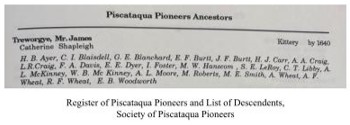
Elizabeth was born around 1639 to James and Katherine Treworgye, and little is known of her early life. Historical records suggest
her father, James, emigrated to the Piscataqua River region sometime around 1640. Records show that her brother was baptized in Devonshire, England, in 1618, suggesting the family lived here prior to their emigration to the New World. By 1657, she was married to John Gilman, a prominent merchant in the local lumber and milling industries.
The Spark of 1684
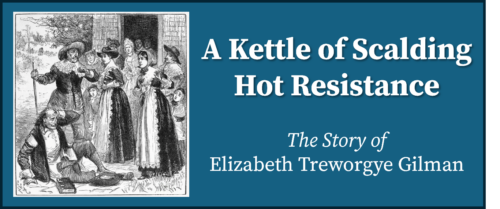
In 1684, New Hampshire was still an English colony, with a royally appointed governor named Edward Cranfield. He was determined to raise taxes on New Hampshire citizens with only the approval of his council, and without the consent of the general assembly, an elected body of state representatives. This set the stage for a conflict that tested the resolve of Exeter’s residents. Constable John Folsom was sent to collect these payments, but failed. Afterward, he told Cranfield that Exeter residents believed “the taxes should be raised by the general assembly,” and because the taxes were “done by the governor and council, they would not pay” (qtd. in Charles Bell, 66). Because of Folsom’s failure to collect payments, Thomas Thurton, the provost marshal of New Hampshire, was sent to recover the debts and impose an additional fine. Thurton went to the home of Edward Gilman, a relative of Elizabeth Gilman. Elizabeth was also present at the home and, as retold by Thurton, stated that she would provide “a kettle of scalding water for him if he came to her house to demand any rates” (Thurton, 1684). Because of this threat, Thurton was forced to leave the Gilman home and failed to collect any additional payments from neighboring residents. After unsuccessful attempts at raising taxes, Cranfield ultimately left his position as governor.
Elizabeth Gilman’s ability to voice her offense at the overreach of British authority echoed the feelings of other women across New
England at the time. Goody Harling of Marblehead, Massachusetts, refused to pay a fine after her husband failed to attend militia training. At the end of King Philip’s War in 1678, colonists had already been taxed additionally to fund the war. Instead of complying, she threatened, “If you touch any goods of mine, I will knock out your braines.” She and her husband were both arrested and jailed
for refusing to pay the fines. Where Goody made threats, Mary Mould did strike a constable and his assistant in 1679 when they served a warrant against her husband for stealing wood. Both the men “received several blows,” and she was forced to appear in court. In a less violent manner, Mary Gardner of Lancaster, Massachusetts, petitioned for compensation for the damage to her field from King Phillips’ War “when an attaque was made upon it by ye enemy.”
A Lasting Legacy
Elizabeth died in 1719, leaving her legacy in Exeter. She gave birth to sixteen children, most of whom lived to adulthood and continued
their family’s prominent role in the town. Two years after his grandmother’s death, Captain Nathaniel Ladd would build the original brick house now known as the Ladd-Gilman House, which has been home to the American Independence Center for the past thirty-five years. Elizabeth and the women of New England provided a courageous beginning for the American Revolution, and should be mentioned
more in the story of our nation. They were among the first to fight against the English government’s taxation and stand up for many of the freedoms recognized by the Founding Fathers.


Sources
Bell, Charles H. History of the Town of Exeter, New
Hampshire. Higginson Book Company, 1888.
“England, Norfolk, Parish Registers (County Record
Office), 1510-1997,” database with images, FamilySearch. (29 May, 2026),
Hingham > Baptisms, Marriages, Burials > 1600-1676 > image 29 of 60;
Record Office, Norwich.
Founding Females. “Elizabeth (Treworgye) Gilman.” National
Society of Colonial Dames, 2024,
nscda.org/wp-content/uploads/2025/06/161-Gilman-Elizabeth-Treworgye-NH-INDEX-BIO.docx.pdf.
“New Hampshire, Town Clerk, Vital and Town Records,
1636-1947,” database with images, FamilySearch, Rockingham > Exeter
> Births, marriages, deaths 1657-1848 vol 1 > image 31 of 162; New
Hampshire Bureau of Vital Records and Statistics, Concord.
Romeo, Emily. “An Almost Inconceivable Foe:
Anglo-American Women and Violence against Colonial Authority in
Seventeenth-Century New England.” Journal of Women’s History, vol.
31 no. 2, 2019, p. 80-100. Project MUSE.
Society of Piscataqua Pioneers. Piscataqua Pioneers
1623-1775: Register of Members and Ancestors 1905-1990. John Cope Abbott,
1991.
Reinhart, Charles Stanley. The Sheriff Resisted.
2021. Accessed 2026.
The Boston News-Letter, 14 September to 21 September
1719, p. 4; Index of Obituaries in Boston Newspapers 1704-1795, Boston
Athenaeum, Vol. 2 (Boston: G.K. Hall & Co., 1968), 428.
Van Deventer, David E. The Emergence of Provincial New
Hampshire. Heritage Books, 1996.