
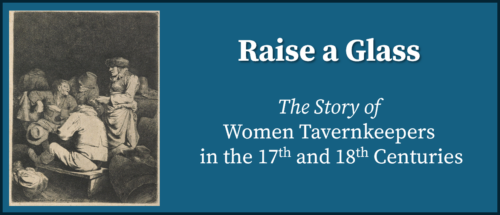
Taverns were a vital part of seventeenth-century America. They served to integrate communities during a time when communication and cohesion were extremely limited. In emerging colonial towns, taverns were among the first buildings built, accurately reflecting early American culture. Not only places for people to eat and drink, taverns served as social hubs, business and legal spaces, and lodging for travelers. Importantly, they also offered colonial women an early path to independence through business operation and ownership.
Colonial Laws
While taverns gave women unique job opportunities, it is vital to understand the broader context of women’s rights during the colonial period. In New Hampshire, as in most British colonies, settlers used English Common Law as precedent for their legal system. This included the doctrine of coverture, which meant married women could not own, buy, or sell real estate or personal property. When a woman married, she became one with her husband: “the very being or legal existence of the woman is suspended during the marriage” (William Blackstone, 1836). Tavernkeeping in New Hampshire was an exemption of this law. It was one of the very few occupations that allowed women to obtain a business license in her own name. It was often widows who ran these establishments to support their families after their husbands’ deaths. Men and women alike had to obtain tavern and innkeeper licenses from the courts to legally run their businesses – one example of equality under the law.
Early Trailblazers
One prominent example is Joanna Tuck, who opened the first tavern in Hampton, New Hampshire with her husband, Robert. In October 1664, Robert died. Following his death, the local court granted Joanna her own liquor and innkeeper license so she could continue to support her family. The following year, Henry Deering was hired to take her place. Although Joanna only had her license for a year, she is still recognized as one of New Hampshire’s first female tavernkeepers.
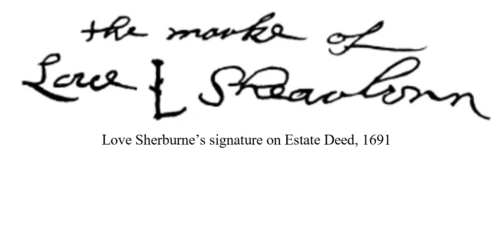
Love Hutchins Sherburne is another impressive figure during this era. She and her husband, Captain Samuel Sherburne, bought the aforementioned Tuck Tavern in 1678. However, in 1691, Samuel was killed during a military mission in Maine, and Love began to run the tavern alone, as a widow with eight children. She did so until 1701, when she was assaulted in the tavern by Ebenezer Webster. He had taken “her by the neckcloth and was in danger of choking her,” as well as striking “her [with] some blows,” according to a witness. She left shortly after the incident and leased the tavern to John Lane. His wife, Joanna Davidson Lane, was given permission to run the tavern under her own name in 1703, though the couple left Hampton less than a year later. Love’s attack represents the broader verbal and physical abuse that women experienced as tavern and innkeepers.
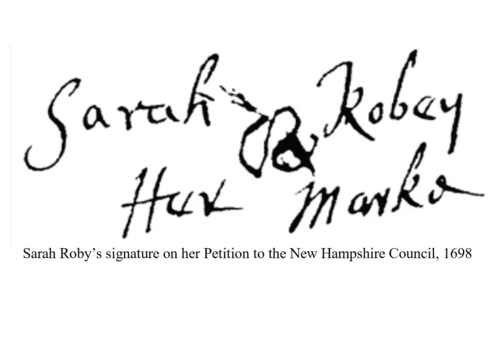
Additional stories highlight opportunities that tavernkeeping offered widowed women. In 1678, Henry Roby, who had already been granted a tavern license, married Sarah Roby. After ten years of marriage, Henry died. Sarah was then granted a license to continue operating the tavern in her own name. In 1698, she requested relief from paying excise taxes on liquor because she was a “pore widow” who “lost the use of [her] limbs.” She also stated that without her husband, and with her health declining, she was struggling to pay the person who managed her household. With this, the colonial assembly of Portsmouth granted her relief “so long as she keep her license in her owne Hands.” Because of this exemption, Sarah was able to keep her tavern until her death in 1703.
This profession was often handed down through familial ties. In 1681, Elizabeth Harvey married Captain Thomas Harvey. Thomas already had a liquor license, but it was transferred to Elizabeth when he was at sea in 1694. After his death in 1697, Elizabeth successfully petitioned to open a tavern in her home in Portsmouth. After two years of running her tavern, she petitioned the General Court to reduce her extra taxes if she also kept a post office. She was then granted exemption “from paying any excise for Beer, ale, or cider, according to the laws of [the] province, so long as she keeps the post office.” In addition to food and drink, Elizabeth provided meeting space for government business and rented rooms to assembly members. In 1714, her son, Thomas, and his wife, Ann, took over the tavern and continued to run it after Elizabeth’s death around 1727. Even after Thomas’ death in 1736, Ann continued to run the tavern and post office. She very successfully ran the tavern until her death in 1756.
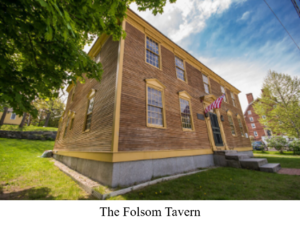
In later years, the Folsom Tavern in Exeter was run by Elizabeth Emery after the death of her husband, Samuel Folsom, in 1790. The tavern was known as “Widow Folsom’s Inn” during her ownership, and she ran it until her death in 1805. The tavern now stands on the property of the American Independence Center, and is managed by the Society of the Cincinnati.
Pioneering Business
It was not until the mid-nineteenth century that coverture laws began to be dismantled in New Hampshire. Remnants of coverture persisted into the 20th century, and traces of its influence remain. The passage of the 19th Amendment, which granted women the right to vote, and the Equal Credit Opportunity Act, which allowed women to obtain credit cards independently, are just two milestones that help strip the impact of coverture laws from American culture. However, it is also important to focus on the good; these tavernkeepers were at the forefront of women’s labor rights in the United States. Though their access to tavern ownership was inherited from their husband, they still proved capable and successful business owners in their own right. Their work helped to introduce women into other nontraditional professions, paving the way for women to work outside the home in early America.
Sources
American Independence Center. “Folsom Tavern.” American Independence Center New Hampshire, 2023, aicnh.org/history/.
American Independence Center. Folsom Tavern. 2026. https://aicnh.org/about/. Accessed 2026.
Blaine, Marcia Schmidt. Ordinary Women: Government and Custom in the Lives of New Hampshire Women, 1690-1770, University of New Hampshire, Durham, A Bell & Howell Information Company, 1999, pp. 172–189, https://scholars.unh.edu/cgi/viewcontent.cgi?article=3061&context=dissertation. Accessed 2026.
Cornelis Bega. The Old Hostess. c. 1660, <a href=”https://www.tepapa.govt.nz”>Museum of New Zealand – Te Papa Tongarewa</a>; Collection: Art; Gift of Bishop Monrad, 1869. JSTOR, https://jstor.org/stable/community.27018162. Etching. Accessed 11 June 2026.
Emma Mitcheltree. Claiming a Seat at the Bar: Women’s Agency & Redefining Domesticity through Tavernkeeping in Colonial America. Documents. Lycoming College, 2026, Student Scholarship & Creative Work. Lycoming College. JSTOR, https://jstor.org/stable/community.42316353. Accessed 4 June 2026.
Founding Females. “Elizabeth (Kelly) Harvey.” National Society of Colonial Dames, 2024, nscda.org/wp-content/uploads/2025/06/197-Harvey-Elizabeth-_Kelly_-NH-Tavern-Owner.docx.pdf.
Hammond, Isaac W. “Sarah Robey’s Petition, Innholder, Hampton, 1698.” Rolls and Documents Relating to Soldiers in the Revolutionary War, Authority of the Legislature, Manchester, NH, 1889, pp. 675–676, Accessed 2026.
Lassiter, Cheryl. “Lady Tavern Keepers of Hampton.” Hampton History Matters, 2019, lassitergang.com/2019/01/10/lady-tavern-keepers-of-hampton/.
Reinke-Williams, Tim. “Women, Ale and Company in Early Modern London.” Brewery History, 2010, www.breweryhistory.com/journal/archive/135/Women.pdf.
Sir William Blackstone, Commentaries on the Laws of England, vol. 1, New York: W. E. Dean Publishers, 1836: p. 355.
What is a Tavern? An In-Depth Look at the Timeless Social & Political Institution in North America. Star Tavern. (n.d.). https://startavern.net/blog/what-is-a-tavern/